Showing posts with label history. Show all posts

Thursday, February 2, 2012

The Annual Miami International Map Fair Takes Place This Weekend at HistoryMiami


This annual Miami International Map Fair showcases antique maps, rare books, panoramas and atlases from around the world! The fair takes place Saturday, Feb. 4-Sunday, Feb. 5, from 10am-5pm, at HistoryMiami, located at 101 W. Flagler Street. 

Peruse and purchase antique maps from some of the finest map dealers in the world. Learn about maps through a series of lectures by experts in the field and enjoy special events held throughout the weekend. For a complete list of events during the Map Fair, please see the official website.

Admission is $5 for HistoryMiami members and $15 for non-members. Tickets may be purchased at the door. Admission includes entrance to the international dealer’s marketplace, access to expert opinions on your own map(s), and the opportunity to win door prizes. Proceeds from Map Fair go toward maintaining and improving HistoryMiami exhibitions, educational programming and community outreach programs.

For more information regarding HistoryMiami’s Miami International Map Fair, call 305-375-1492, e-mail mapfair@historymiami.org, or visit the official website.

The Fitzgerald & Kanner Trust for Historic Maps was established to endow the Miami International Map Fair, to support the growth of HistoryMiami's map collection, and to foster an appreciation of historic maps through exhibitions, publications and educational programming.

In 1990 an anonymous donor established the Joseph H. Fitzgerald Trust for Historic Maps as a part of the museum's endowment. The Trust is named after  Joseph H. Fitzgerald in honor of his long service to HistoryMiami and avid interest in maps. The Trust has grown through donations of generous friends and map enthusiasts. For more information about the Trust please call 305-375-1615 or e-mail  development@historymiami.org.

Like us on Facebook
Follow us on Twitter
Download the FREE iPhone App

Friday, January 27, 2012

The Jewish Museum Of Florida Presents "Max Miller: Final Mourner's Kaddish: 333 Days in Painting" Opening Jan. 31

Cuban Hebrew Congregation, Miami Beach, FL,
Watercolor, 2005

After the death of his father, Murray A. Miller, artist Max Miller chose to undertake the custom of saying Kaddish, the Jewish prayer of mourning. This prayer, exalting the name of God, is recited in the presence of a congregation daily for eleven months. 


Miller, who grew up Orthodox with Yiddish as his first language said, "The Kaddish provided me with time to grieve and reflect on spiritual aspects of life and death, and because of this I felt compelled to create images that captured my response to what I was experiencing." 


The artist's grief provided the inspiration for a vivid, moving and cathartic account of his experience of honoring his father through the daily recitation of the Kaddish.


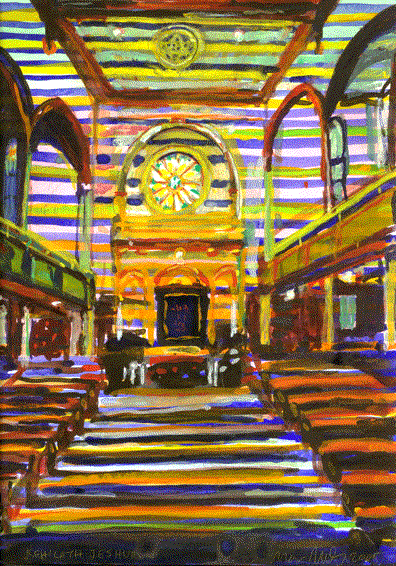
As an historic record and for personal reasons, Miller created a watercolor of each the synagogues he visited during the 333 days of saying Kaddish in New York, Vermont, Ohio and Florida (including Congregation Beth Jacob, that is now the Jewish Museum of Florida). 


Beth Jacob, Miami Beach, FL  
Watercolor, 2005

The 50 vibrant watercolors, considered by the artist to be a coherent unit, are painted on paper. As a whole, the collection suggests the diversity of the social and religious settings that Miller frequented, as well as the breadth of personal transformation and learning he experienced over the course of those eleven months.


Though the form varies, humanity's expression of mourning transcends time, society, and culture. The extraordinary body of work that ensued is an intimate document of Miller's faith, observance and the Jewish community. The ultimate unity of the Jewish people is found in these remarkable works.


Each image is distinct in its orientation, composition and focus. Depictions range from exterior to interior, from human to architectural portraits, from limited to wide-ranging color schemes. The richness of his color and line inscribes the vitality of faith and continuance of ritual and tradition. The exhibition also includes a stunning portrait of Miller's father, against a silver leaf background, an image of iconic and descriptive power that sets the tone for the show.


Kehilath Jeshurun, Upper East Side, New York City  
Watercolor, 2005


Accompanying the images are the artist's commentaries, based on his thoughts, feelings and experiences with those he met during this pursuit. While honoring the Jewish tradition of memorializing a parent, Miller came to learn a great deal about his father and their shared heritage.

Though the daily ritual of saying Kaddish has formally ended for Miller, bringing this project to fruition provides an opportunity for those within the Jewish community, and for those in other communities, of all ages, to witness and honor the tradition of the Mourner's Kaddish, and to reflect on their own humanity and spiritual journeys.


This exhibition by Max Miller originated at the Yeshiva University Museum in New York City and is sponsored by the New York Foundation for the Arts.  


Max Miller: Final Mourner's Kaddish - 333 Days in Painting will be on display at the Jewish Museum Of Florida January 31-May 13, 2012.


Max Miller
Max Miller is known for his abstract paintings that embrace color and line, as well as his figurative paintings of human and animal subjects. He has had exhibitions in New York City and throughout the East Coast. He received his BFA from Rhode Island School of Design and MFA from Yale University. He has been awarded numerous fellowships, including a New York Foundation for the Arts, Guggenheim, National Endowment for the Arts and two Pollock-Krasner Foundation Grants.


The Jewish Museum of Florida is housed in two adjacent lovingly restored historic buildings on South Beach that were once synagogues for Miami Beach's first Jewish congregation. The Museum's focal point is its core exhibit MOSAIC: Jewish Life in Florida  - 1763 to the Present and temporary history and art exhibits that change periodically. Currently on display: Wooden Synagogues of Poland and the Florida Connection through March 18, 2012. A Collections & Research Center, several films, Timeline Wall of Jewish history, Museum Store filled with unique items and Bessie's Bistro complete the experience for visitors of all ages and backgrounds.


Accredited by the American Association of Museums, the Museum is located at 301 Washington Avenue, Miami Beach 33139, and is open daily 10 a.m. to 5 p.m., except Mondays, Civil and Jewish holidays. Admission: Adults/$6; Seniors/$5; Families/$12; Members and children under 6/Always Free; Saturdays/Free. For information: 305-672-5044 or www.jewishmuseum.com.


Welcome to Miami and the Beaches
Like us on Facebok
Follow us on Twitter
Download the FREE iPhone App

Thursday, January 5, 2012

Jewish Museum Honors Florida's Jews from Poland During Florida Jewish History Month

The Jewish Museum of Florida, 301 Washington Ave., Miami Beach


       This year's observance of Florida Jewish History Month, in conjunction with the Museum's current exhibit, "Wooden Synagogues of Poland and the Florida Connection," will honor the 80% of American Jews whose origins are from Poland.
       For the January 8 kick-off event, the Jewish Museum of Florida welcomes Floridian families with Polish roots, who will share their experiences in a panel discussion. Bring family and friends to join this FREE celebration. Walk-ins welcome or RSVP to 786-972-3175 or e-mail info@jewishmuseum.com. 
       Jews have lived in Poland for more than 1,000 years. Poland was the center of the European Jewish world before World War II, when the Holocaust resulted in the death of 90% (3 million) of the Polish Jews. By preserving the memories of families, such as those on this panel, the Museum is able to keep Jewish cultural heritage alive and transmit it to future generations. 
       At the January 8 kick-off event, the Museum will award cash prizes to the winners of its statewide student creative writing contest. The Museum challenged middle and high school students to connect to their own cultural heritage, by answering the following question: "How does a place tell a story that represents your cultural heritage?"
       As part of the celebration, Joe's Stone Crab restaurant is providing their famous key lime pie, designated in 2006 as Florida's official state pie. The founders of Joe's, Joe and Jennie Weiss, were the first Jews to settle on Miami Beach in 1913. Joe's is still owned and run by the family, and has been open since 1913.
       The concept for Florida Jewish History Month began at the Jewish Museum of Florida. Founding Executive Director Marcia Jo Zerivitz worked closely with legislators to translate the Museum's mission into a statewide observance. In April 2003, Governor Jeb Bush signed a bill into that officially designated the month of January as Florida Jewish History Month. Florida is the first state in the nation to have a month dedicated to the tremendous contributions of Jews in its state. 
       The success of Florida Jewish History Month inspired the legislation for Jewish American Heritage Month, also initiated by the Museum, and observed each May, with a Proclamation signed by President George Bush in April 2006. 


* * * * * * * * * *

Rachel Kosowski, 1938.
       The family of Rachel Kosowski (Abramowitz) settled in Kosov, Poland about 300 years ago. She was born in Yanov in 1928. The family's plan to immigrate to Palestine on September 7, 1939 was thwarted by the outbreak of World War II on September 1, when Germany invaded Poland. The family was arrested and sent to Siberia.
       In 1946, they were allowed to return to Poland to vote for the Communists; however, they found severe anti-semitism and government-sponsored pogroms there. An organization called Bricha (escape) had been formed to find and bring Polish Jews to Germany on their way to Palestine. Bricha rescued Rachel's family and sent them to a DP (displaced persons) Camp. Rachel met her husband there, U.S. Army Chaplain (1st Lieutenant) Mayer Abramowitz. The couple moved to Miami Beach in 1951.

Maria (2nd from left) and son, Allan
Horowitz 
(3rd from left), with Russian
soldiers outside of Warsaw, 1946.
       The family of Allan Horowitz (Hall) from Krakow walked east to the Russian area in 1939, when the Germans overran the western part of Poland. In 1941, when the Germans came, the family went into hiding. After the war they were liberated.
       Father, Edmund, worked for the Polish government but was purged by the Soviets and sent to Siberia. He broke out of prison and fled to Paris with his wife, Maria. Edmund and Maria separated from their sons so that the Soviets could not use the children as hostages. The family eventually reunited and immigrated to the U.S. in 1947.   

Shomir Atzarim Zionist Organization,
Poland Hebrew School, Biala Podlaska,1939.
Alice Weinglas (2nd row, top, 1st from left)
with classmates. Only five of this
group survived the Holocaust. 
       Alice (Weinglas) Vinik was born in Biala Podlaska between the two world wars. In late 1939, when the Germans came, her family escaped to the Russian side. They were captured by Russian soldiers and forced to live and labor in the forest.
       Alice met her husband, Max Eiman from Bielsko, Poland. The family members were finally released and reunited in 1946 and returned to Poland. Due to the antisemitism and pogroms, they escaped and were smuggled across the borders.
       After time in Displaced Persons (DP) Camps in Austria and Germany, Alice came to America in 1949, and settled in Miami Beach in 1956.


Louis Schneider wearing
an "Acolyte" outfit, 1944.
       Louis Schneider's parents, Joseph and Debora, were born in Lipsko/Narol. His family was separated when his father was caught by French police in 1942. Louis' mother attempted to smuggle Louis and his sister into Switzerland, but they were caught at the border.
       While traversing northern Italy, their train was bombed by American planes and they were rescued from the wreckage by Italians. Louis spent the rest of the war hiding as "Luigi Sarto" in a Catholic monastery in Italy.
       The family miraculously reunited in 1946.


* * * * * * * * * * 

       The Jewish Museum of Florida is housed in two adjacent lovingly restored historic buildings on South Beach that were once synagogues for Miami Beach's first Jewish congregation. The Museum's focal point is its core exhibit "MOSAIC: Jewish Life in Florida: 1763 to the Present." Interesting history and art exhibits change periodically.
       Currently on display are: "Wooden Synagogues of Poland and the Florida Connection," through March 18, 2012 and "Rabbi Irving Lehrman: His Life & Art," through January 15, 2012. A Collections & Research Center, Timeline Wall of Jewish history, several films, Museum Store filled with unique items and Bessie's Bistro for snacks complete the experience for visitors of all ages and backgrounds.
       Accredited by the American Association of Museums, the Museum is located at 301 Washington Avenue, Miami Beach, and is open daily 10 a.m. to 5 p.m., daily, except Mondays, Civil and Jewish holidays. Admission: Adults-$6; Seniors-$5; Families-$12; Members and children under 6-Free; Saturdays-Free.
       For information please call 305-672-5044 or visit the website, www.jewishmuseum.com. 

The official logo for Florida Jewish History
Month, created by one of Miami's most
famous artists/residents, Romero Britto.

Welcome to Miami and the Beaches
Like us on Facebook
Follow us on Twitter
Download the FREE iPhone App

Tuesday, January 3, 2012

Let the Experts Show You Around Town! Book A Tour with HistoryMiami Today

Downtown Miami's skyline, including the famed InterContinental Hotel.

Delve into the past and experience the sights, sounds and cultures of South Florida with a City Tour or Private Tour.

HistoryMiami offers educational tour opportunities for adults of all ages to learn more about the history of the region. Tour guides look forward to welcoming visitors on a memorable journey of the region’s history, both on-site in the museum galleries or off-site at the many historic neighborhoods, landmarks and sites throughout South Florida.

City Tours feature walking, bike, boat, and coach tours with internationally-acclaimed historian, Dr. Paul George, and eco-historian Frank Schena, as well as other tour guides, prepared to share their expertise on various topics related to Miami and South Florida history. 

Dr. Paul George
For more than two decades, Dr. George has toured his way to local, national and international acclaim by conducting city tours around South Florida. A Miami native, prolific author and Miami-Dade College professor, he has gained fame for his uncanny ability to recall the most impressive details about the people and places that make the region so unique.

Private Tours are customized to meet each group’s individual needs. All personalized tours include a one-time free admission pass to the HistoryMiami Museum, located at 101 West Flagler Street in downtown Miami. For more information please call the City Tours Department at 305-375-1621, or e-mail citytours@historymiami.org.

Up-Coming Tours:


For a complete list of tours, please visit: 


Like us on Facebook
Follow us on Twitter
Download the FREE iPhone App

Friday, September 16, 2011

"Wooden Synagogues of Poland & The Florida Connection" Exhibit Now Open at the Jewish Museum of Florida

Gombin synagogue model
The Jewish Museum of Florida's newest public exhibition tells the stories of Polish shtetls (small towns in Eastern Europe with a sizable Jewish population) and some of their Jewish families who settled in Florida. 


The exhibit runs through March 18, 2012.


The genesis of the exhibit was the donation by Englishman Peter Maurice of 10 models of 17th-18th century Polish wooden synagogues. He researched and built the 1/40th-scale models  from 2003-2007.


Jews have lived in Poland for more than 1,000 years. About 80 percent of the American Jewish community has origins in Poland. That is not surprising, as we know that this was the center of the European Jewish world with more than three million Jews before the Holocaust. The focus of life for these Polish Jews was their synagogue. For 400 years prior to World War II, the Jews of the shtetls built approximately 1,000 wooden synagogues, because timber was plentiful. According to some art historians, the wooden synagogues of Poland, with their painted and carved interiors, were a truly original and organic manifestation of artistic expression-the only real Jewish folk art in history.


These beautiful and unique 17th and 18th century Polish wooden synagogues no longer exist. During World War II, the Nazis burned to the ground those still standing. Some synagogues built in the 19th and 20th centuries have been found in Poland and what is now Lithuania and are in deteriorated conditions.


This exhibit conveys the enormity of what was lost during World War II. Poland was the place where the Nazis built most of the death camps. This is the place where most of Europe's Jews perished.


The Museum's founding executive director and chief curator, Marcia Jo Zerivitz, said, "While we have various models in our collections, from a kosher bakery in Lakeland to a model of our very own Beth Jacob synagogue, this donation is so unique in that it brings a taste of old Polish Jewish life to modern day Miami Beach. So many Floridian Jews have a family history from Polish shtetls. These beautiful, unique models evoke memories of our heritage. When you look at them, you can almost hear the davening (praying) from within the walls and recall the pain of suffering of all Eastern European Jews from the period of the Holocaust when the Nazis destroyed these structures and most of the Jewish people. Through the creation of these models, Peter Maurice ensured that an element of Jewish life in Poland would not be forgotten. And we are so honored that Maurice chose the Jewish Museum of Florida from all the museums in the world to tell this compelling, significant story."

Dombek Family, Sosnowice, Poland, c.1910
Many Floridian Jews have a family history from Polish shtetls. To make the Florida connection, the Jewish Museum of Florida invited Jewish families to submit material evidence of their Polish roots for this exhibition. The curatorial staff researched each of the towns represented by the wooden synagogue models and by the families, so the story includes photographs, artifacts and documents from more than 30 towns and nearly 40 families.


The Jewish Museum of Florida on South Beach is housed in two adjacent lovingly restored historic buildings that were once synagogues for Miami Beach's first Jewish congregation. The focal point of the Museum is its core exhibit "MOSAIC: Jewish Life in Florida 1763 to the Present" and temporary history and art exhibits that change periodically. Current exhibits are "Seeking Justice: The Leo Frank Case Revisited" through August 14 and "Isaac Bashevis Singer & His Artists" through August 28. A Collections & Research Center, several films, Timeline Wall of Jewish history, Museum Store and Bessie's Bistro complete the experience for visitors of all ages and backgrounds.


Accredited by the American Association of Museums, the Jewish Museum of Florida is located at 301 Washington Avenue, South Beach and is open daily 10am-5pm, except Mondays and Civil and Jewish holidays. Admission: Adults/$6; Seniors/$5; Families/$12; Members and children under 6/Always Free; Saturdays/Free. For information call 305-672-5044 or visit www.jewishmuseum.com.


Welcome to Miami and the Beaches
Like us on Facebook
Follow us on Twitter