Showing posts with label everglades. Show all posts

Friday, December 2, 2011

Celebrate The Holidays With Exciting Events At Zoo Miami


This holiday season Zoo Miami is hosting a myriad of exciting and fun activities for everyone. Enjoy a Holiday Hoedown, eight nights of Zoo Lights, Dinner with Santa, and watch the animals open their special holiday gifts!


Zoo Miami is located at 12400 SW 152 Street, Miami. General zoo admission is $15.95/adult and $11.95/child (3 -12) plus tax. Children under 3, Zoo members and parking are free. Zoo Miami’s regular hours are 9:30 a.m.-5:30 p.m.; ticket booths close at 4 p.m.


The Holiday Hoedown, Zoo Lights, Dinner with Santa are special events with separate admission prices. To save time, buy tickets online at www.zoomiami.org.  

Holiday Hoedown

Alligator Ron's Holiday Hoedown is a fundraiser for Zoo Miami’s up-coming exhibit, Florida: Mission Everglades, set to open in 2014. It will take place on Dec. 3 at Green Glades Ranch (21111 SW 16 St., Weston) from 6:30 p.m. to 11:30 p.m.


There will be live music from the country band Shadow Creek, an open bar, and great BBQ all to benefit the Florida: Mission Everglades. Since it is a hoedown in December, the attire requested is Holiday Western Wear. Light up cowboy boot mugs will be sold for a $20 donation.


Main event tickets are $150 each and VIP tickets are $250 each. For more information and to purchase tickets, please visit www.holidayhoedown.com


The lighted giraffes at Zoo Lights
Zoo Lights

At Zoo Miami, guests can enjoy beautiful animal-shaped lights as they stroll zoo walkways during the 8 nights of Zoo Lights, have Dinner with Santa, and watch the animals open their specially-prepared gifts during Holiday Gifts for the Animals.


The zoo’s glorious grounds come to light for eight brilliant nights during Zoo Lights, Dec. 16-23 from 7 p.m.-10 p.m. (ticket booths close at 9:30 p.m.). Guests can enjoy dozens of bright animal-shaped lights along our walkways, listen to wonderful holiday music, sip hot chocolate, munch on delicious cookies, and take a ride on a camel, the wildlife carrousel or the hippo slide (the world’s largest inflatable slide). Included with admission is a pair of 3-D glasses, which will make the Zoo Lights experience even more engaging and amusing. 


General admission is only $5 per person plus tax. Food, beverages, camel rides, carrousel and hippo slide are all available at additional costs.

Dinner With Santa

Dinner with Santa will take place on Dec. 17, from 7:30 p.m.-9:30 p.m. Bring the kids to meet him before he has to rush back to the North Pole!  Enjoy a delicious holiday dinner with the family, photos with Santa, a holiday plush gift and holiday craft-making for the little ones! 

Dinner with Santa admission includes parking, entry to Zoo Lights from 7 p.m.-10 p.m. and a classic holiday menu of fresh roasted turkey with homemade gravy, baked ham, candied sweet potatoes with melting marshmallows, herbed buttery carrots, homemade cranberry sauce, dinner rolls with butter, homemade seasonal pumpkin cake with cream cheese icing, strawberry-infused lemonade, and cranberry mint-infused water.


General admission is $39.95 per adult and $33.95 per child ages 3-12. Zoo members are $36.95 per adult and $30.95 per child ages 3-12. Children ages 2 and under are free. To make a reservation, please call 305-251-0400, Ext. 84941.

Gifts for the Animals

Another fun family activity is Holiday Gifts for the Animals!  Every weekend in December, including Christmas Day, watch the animals joyfully open holiday gifts prepared by zookeepers and volunteers. The animals enjoy opening up their enriching gifts and visitors will be entertained watching them! See schedule below for details.


Saturday December 3
10:30 a.m.: Great Indian hornbills at Wings of Asia will receive papier maché ornaments filled with meaty treats.
1:30 p.m.: Pygmy hippo will eat giant red and green popsicles.

Sunday December 4
10 a.m.: Jaguars will get their own holiday tree – an Australian pine tree with all of the trimmings including catnip!
2 p.m.: Asian bear will receive a gift box filled with treats.

Saturday December 10
10:30 a.m.
Great Indian hornbills at Wings of Asia will receive papier maché ornaments filled with meaty treats.
11:30 a.m.: Lions will get red and green ice treats.
3 p.m.: African elephants will get giant candy canes.

Sunday December 11
10:30 a.m.: Tigers will cool off with their holiday ice treats.
2 p.m.: Gorilla will receive their own holiday popsicles.

Saturday December 17
11:30 a.m.: Santa will deliver sacks filled with treats for the Orangutans.
1 p.m.: Asian elephants will get a giant holiday ribbon.

Sunday December 18
12:30 p.m.: Meerkats will receive a gift box filled with bugs!
2:30 p.m.: Great Indian hornbills at Wings of Asia will receive papier maché ornaments filled with meaty treats.

December 24, Saturday
10:30 a.m.: Great Indian hornbills at Wings of Asia will receive papier maché ornaments filled with meaty treats.
1 p.m.: Asian elephants will get edible holiday ornaments.
2 p.m.: A holiday tree with all of the trimmings will be delivered to Amazon & Beyond for the agouti, chestnut-mandibled toucan, great curassows and black-throated magpie jays.

Sunday December 25
1:45 p.m.: Chimpanzees will receive a holiday surprise!
3 p.m.: African elephants will receive their own giant holiday tree!

Saturday December 31
11:30 a.m.: New Guinea singing dogs will receive New Year’s ball treat dispensers.
1:30 p.m.: Warthogs will get New Year’s decorated treat boxes.

Sunday January 1
2 p.m.: Sun bear will receive treat boxes for the New Year.
3 p.m.: African elephants will get papier maché animals.


Welcome to Miami and the Beaches
Like us on Facebook
Follow us on Twitter
Download the FREE iPhone App

Monday, November 7, 2011

New, Interactive Art Installation At Miami International Airport By Artist Christoper Janney


Harmonic Convergence, the newest, large-scale art installation by artist, architect and composer Christopher Janney, is nearing completion at the Miami International Airport. Janney terms Harmonic Convergence “an abstraction of South Florida in color and sound.”

The official dedication of Harmonic Convergence, hosted by Miami-Dade County’s Art in Public Places, will take place in conjunction with Art Basel Miami Beach and Design Miami 2011, held Dec. 1-4. Art Basel Miami Beach is the largest art fair in the U.S.

Harmonic Convergence features a 72-foot-long window wall with diamond-shaped panes of colored glass in front of a white structural steel “X-Bracing” frame. With a palette of over 150 transparent colors, Janney has created a gradually changing pattern ranging from deep reds to bright violets, similar to a rainbow.

The project is part of Miami-Dade County’s Art in Public Places program and is located in the passenger connector walkway that is the entrance into the airport from the new the “MIA Mover” automated transit system.

As travelers enter the space, they will hear a complex set of sounds Janney recorded during trips to the Florida Everglades, scuba dives in the ocean, and other natural environments of South Florida. In addition, two video cameras installed in the ceiling feed information to the computer regarding the pedestrian activity within the space, influencing the density of the sound-score. At the top of each hour, a short composition with percussion instruments plays, marking the time of day.

“This is my fifth project in South Florida,” Janney states. “It is one of my favorite places in the world. I love the sounds of the subtropics most particularly the Everglades, the ocean shore and underwater sounds, especially sounds both real, as in whales and porpoises, and imagined, i.e. mermaids and Atlantis."

Harmonic Convergence is a replacement for Janney’s 1997 airport commission Harmonic Runway, which was removed from Concourse A after changes to the airport occurred due to 9/11 security. That former artwork had become an icon of South Florida, featured in numerous magazines and on film including the Harrison Ford feature, “Random Hearts” and the Nicholas Cage film, “8MM.”

Trained as an architect and jazz musician, Janney is an American artist whose work explores the relationships between sound and architecture, often-transforming otherwise ordinary spaces into “hyper-reality” environments.

Educated at Princeton University and the Massachusetts Institute of Technology, Janney has explored the intersection of architecture and music for more than 30 years, creating temporary and permanent installations throughout the U.S. and Europe.

Welcome to Miami and the Beaches
Like us on Facebook
Follow us on Twitter
Download the FREE iPhone App

Thursday, September 30, 2010

Fall-ing for the Everglades

Big Cypress Marsh
In most places across the country, the fall season heralds a time of transition.  It's palpable. It is seen and felt in the weather, the foliage, the attitudes of people and their work ethic. Subtle as it might seem in South Florida, there is a period of transition in the Everglades as well, most notably in the form of cooler temperatures and an increase in the number of avian and human visitors. It's exactly the time of year that interest in visiting and learning about America's Everglades heats up.Encompassing more than 1.5 million acres, Everglades National Park is the third largest national park in the lower 48 states, behind only Yellowstone and Death Valley in size. The total land area occupied by the Everglades was once 8 million acres; drainage and development have reduced that, but is still HUGE! 


Everglades National Park provides the best way to see the Everglades up close; there are lots of boardwalks and trails for hiking and biking, allowing visitors to see a myriad of birds, fish and reptiles, as well as exotic plants - the Everglades is home to 67 endangered or threatened species! The Anhinga Trail, named for the birds that flock to that area, is also a great place to see Florida alligators in the wild. 


Cypress Prairie
Why is the Everglades so important to South Florida? The massive slow-moving river - 100 miles long by 60 miles wide - allows water to filter through to the aquifer that provides most of South Florida's drinking water, for one thing. Commercial and recreational fishing are part of life in South Florida and the Everglades provides plenty of opportunities for both, as well as an ecosystem with a variety of life seen nowhere else!  Fall and winter, when the water is lower, are the BEST time to see the Everglades. For more information about the "River of Grass," its importance to the planet and efforts to restore and save it, visit the Everglades Foundation online. The National Park Service website about Everglades National Park has all the info needed to plan a fun trip to the Everglades, as well as maps and camping information. 


In the meantime, check out these fun facts about the Everglades, courtesy of the Everglades Foundation
  1. The Everglades comprise the largest wetlands located in the lower 48 states in the U.S.A.
  2. While it is often described as a swamp or forested wetland, the Everglades is actually a very slow-moving river.
  3. Once spread out over 8 million acres, the Everglades ecosystem reaches from the Kissimmee River to Lake Okeechobee where waters from the lake slowly moved south toward Florida Bay completing the Everglades ecosystem.
  4. Native Americans living in and around the river called it Pahayokee (pah-HIGH-oh-geh), the "grassy waters."
  5. Birds were so plentiful in the Everglades that it was said they “darkened the sky” when they took flight.
  6. America’s Everglades are home to 67 threatened or endangered species.
  7. Just months after Florida became a state in 1845, the legislature took the first steps that would lead to draining the Everglades.
  8. Periphyton, the mossy golden-brown substance that is found floating in bodies of water throughout the Everglades, is the dominant life form in the River of Grass ecosystem.
  9. The Everglades is the only place in the world where the American Alligator and the American Crocodile co-exist in the wild.
  10. Mosquitoes play a vitally important link in the Everglades food chain. The larvae of grown mosquitoes provide food for a variety of native fish that are critical to the diet of wading birds.
  11. The Everglades is a World Heritage Site and an International Biosphere Reserve.
  12. The ubiquitous grassy plants known as sawgrass (a sedge), feature serrated, razor-edged blades of grass that are so sharp, they have been known to cut through clothing. 
Photos courtesy of The Everglades Foundation. 

Friday, March 5, 2010

Lights, Camera, Action!

The beauty of Miami's tropical environment and beaches have been the setting for many television shows, movies and commercials since moving pictures were invented; the earliest film made in Miami was a short silent comedy called The Taming of Mary - in 1912!  The film and television production industries are an important part of Miami's economy.  According to FilMiami, a Miami-Dade County agency that keeps track of on-going projects, as well as issuing permits for work, in February, 2010, alone, productions added more than $16.5 million to the Miami economy and employed more than 1700 local people.  More than 200 production permits have been issued in just the first two months of 2010. On an annual basis, according to Filmiami, "The Film & Entertainment Industry employs approximately 10,000 full and part time workers and has an annual impact of $2 billion dollars to the local economy with permitted productions contributing more than $150 million." 


There are shows set in Miami which were never filmed here; The Golden Girls is one of the best known, as is the classic 1950s movie Some Like It Hot, starring Marilyn Monroe, Tony Curtis and Jack Lemmon. Even CSI: Miami only tapes in Miami when there are shots that can't be done elsewhere, such as skyline or Everglades scenes. The rest of the time, the show films in Los Angeles. Before re-locating to Los Angeles, FX's top drama Nip/Tuck was also set in Miami but didn't film here.  There are also productions which are taped or filmed in South Florida that are NOT supposed to be set here, but that's far less common because Miami is far too distinctive-looking to stand in for any other city! 


Of course, the largest category of productions made in South Florida are those which are both set in and made here. The beaches, sun, sparkling water, tropical foliage and wildlife are almost always included in those projects. While the most famous TV show ever made here, Miami Vice, put Miami and Miami Beach back in the public eye and is credited with rejuvenating and reviving Miami, current hot series set here include USA Network's Burn Notice, the #1 rated original show on cable, and Showtime's critical darling Dexter. Even classic series Flipper and Gentle Ben were made in South Florida, although their settings couldn't be more different; Flipper was made at the beach while Gentle Ben was set in the Florida Everglades. 


Movie-making in Miami has produced some of the most exciting and sexy movies ever, including Scarface, Body Heat, Wild Things, Bad Boys, Out of Sight (from the novel by Miami author Elmore Leonard), Any Given Sunday, Goldfinger, Thunderball, The Transporter 2 and 2 Fast 2 Furious. Comedies made in and about Miami include The BidAce Ventura: Pet Detective, There's Something About Mary, Marley and Me, Meet the Fockers, Police Academy 5 & Revenge of the Nerds 2, and the classic coming-of-age movie Porky's, partially filmed in what is now Oleta River State Park in North Miami Beach. 


Even the reality TV craze has left its mark on Miami. The 1996 season of MTV's The Real World was made here and has been followed by a season of Top Chef, a Key West version of The Real World, occasional episodes of Hogan Knows Best and Brooke Knows Best, as well as A&E's popular Miami Ink, about a South Beach tattoo parlor. The 1960s incarnation of The Jackie Gleason Show also broadcast from Miami Beach, and is commemorated by the Fillmore Miami Beach Jackie Gleason Theater on the beach. 


With Univision, Telemundo and TeleFutura based in Miami, there's always a lot going on in the Spanish-language TV world. Telenovelas, Spanish-language soap operas, are huge hits for these networks. They are also recognized for their excellent local programming and news coverage of the Spanish-speaking world. During the recent earthquake in Chile, MSNBC regularly cut to the Hialeah headquarters of Telemundo for updates because Telemundo already had reporters in Chile. 

Wednesday, August 5, 2009

Go Wild in South Florida!

Florida's variety of wildlife is majestic and vital to the health of its delicate ecosystem. The Everglades and the reefs along the coast are home to lots of interesting species; Florida is also the winter home to almost every kind of bird on the eastern seaboard. In South Florida, the great outdoors is magnificent!

Alligators are important to the Everglades for many reasons, including controlling the rodent populations and keeping the wetlands wet during the dry season, thanks to the water that gets stored in their gator holes. Male alligators tend to be about 14 feet long, while females are closer to 10 feet when fully grown. Although alligators were endangered at one time due to over-hunting for their hides, there are more than a million of them in Florida today! While alligators are in almost every inland body of water in Florida, the best place to see them is Everglades National Park.


A close cousin to the alligator, the only American crocodiles in the US live at the tip of Florida, in Florida Bay. More docile than alligators, Florida's crocs are also smaller, usually only about 5 to 6 feet long when adults. In recent years, several Florida crocs have somehow made it to the canals and lakes of the University of Miami. Crocodiles are a protected species; there are only about 1,000 of them left in Florida today.

Three main varieties of sea turtles nest in Florida: green sea turtles, leatherbacks (which, as the name implies, do not have a bone type shell) and loggerheads. All three are endangered species. Sea turtles navigate by using the magnetism of the earth; females return to the nesting grounds where they were born year after year. Florida is, in fact, home to the largest nesting ground for loggerheads in the US! Sea turtles can live to be 80 years old. The biggest threat from humans to sea turtles is destruction of their nesting grounds and their entanglement in fishing nets or floating garbage such as balloons and six-pack rings.

Manatees are gentle giants which can be seen grazing on plant life in the canals and mangrove hammocks of South Florida. Distantly related to elephants, manatees can weigh up to almost 1800 pounds! Even their newborn calves weigh about 65 pounds. Like whales, they surface for air every 20 minutes or so. Half their time is spent asleep, and their very low metabolisms keep manatees in warm areas. Manatees are absolutely no threat to humans, and are in fact curious and friendly, but humans, especially in propeller driven boats, have harmed countless manatees. Of the nearly 300 manatee deaths reported as caused by humans in Florida in 2006, the majority involved boats, so be watchful on the water!

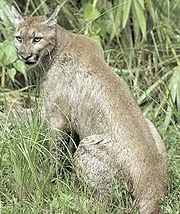
Critically endangered right now, the Florida Panther lives only in a few places in southern Florida these days. Living only in Everglades National Park, Big Cypress National Preserve and the Florida Panther National Wildlife Refuge, the panther population is down to less than 100 of these beautiful animals and occupies only 5% of its former territory. Development has been the biggest threat to panthers; driving at night in the Everglades, keep an eye out: automobiles are the leading cause of death for panthers.

The sailfish is one of the most sought after game fish in the world and it can be found in plentiful numbers at the edge of the Gulf Stream right here in South Florida throughout the winter months. Characterized by its large dorsal fin and elongated bill, the sailfish is capable of powerful runs, acrobatic jumps and reel blistering dives which may make your arms regret the ever tangled with this great fish.

Sometimes called the "ghost of the flats," the bonefish is the pound for pound best fighting fish in the world. The first run of a bonefish, whether caught on fly gear or conventional tackle, will astound you as many a fish have stripped the reel completely of line leaving the angler only to wonder what might have been. Biscayne Bay, in the shadow of downtown Miami, is the perfect place to target wintertime bones.

Largemouth Bass is incredibly popular with locals and out-of-towners alike. "Old bucketmouth" has long been a staple of South Florida game fishing in freshwater and with places like the Everglades, Lake Okeechobee and literally hundreds of miles of inland canals, there is no shortage of water to fish for this great species.